Our Implant team is headed up by Stephen Nicoll who has a wealth of experience, having placed and restored well over 5,400 implants his time is now devoted to implant dentistry. His ability to inform patients and put them at ease means you will be in a very safe and confident pair of hands. Steve is supported by his well-trained, calm and caring implant nurses.
For any implant queries with Dr Nicoll please contact our implant treatment co-ordinator [email protected]
Why replace missing teeth?
If you are missing one or more teeth there may be other things you miss. You may miss your natural smile or the full function of being able to crunch into an apple. Tooth loss can cause additional problems over and above the obvious aesthetic and functional considerations.
These include:
- Shrinkage of the bone at the extraction site.
- Drifting and over eruption of adjacent teeth.
- The increased risk of decay and gum disease in the surrounding teeth.
- Increased load and wear on remaining teeth.
- Loss of self-confidence.
- Difficulty in swallowing.
What is a dental implant?
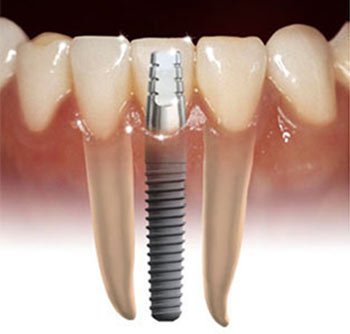
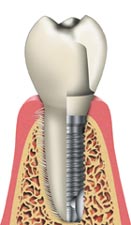
Modern dental implants are titanium cylinders that are embedded into the jaw bone to take the place of the missing tooth root. Once or before Osseo-integration has occurred (a process in which the bone fuses to the surface of the implant) a replacement tooth can be secured to the top of the implant. The new tooth can look, feel and perform just like a natural tooth. It is also possible to use multiple implants to support a bridge or denture.
 What are the benefits of implants?
Implant supported teeth are more comfortable than conventional dentures because there is no slipping or movement, because the implants are fixed they feel and function like natural teeth. This eliminates some of the key worries of denture wearers and improves self-confidence.
Dental implants are an alternative to conventional bridgework. They eliminate the need to grind down healthy teeth and do not place additional loads on the teeth supporting the bridge. The drilling of healthy tooth generally leads to problems and more invasive dentistry, the downward spiral will then be compounded as one destructive treatment leads to another each having a worse prognosis than the one that preceded it.
When teeth are missing the surrounding bone shrinks. Implants function in and stimulate the bone, this maintains the shape and structure of the jaw.
Images of a typical case to replace a missing upper incisor
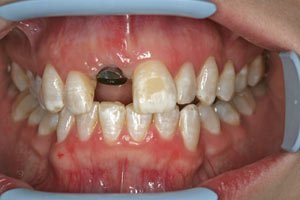
Implant in situ with healing abutment – the patient wears a temporary denture over the abutment.
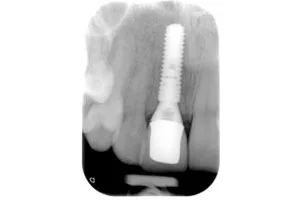
X-ray image of the implant showing trial seating of the final abutment and crown. The implant replaces the natural tooth root without causing any damage to the adjacent teeth.

Image following cementation of the crown to the abutment.
What is involved in the implant process?
The dental implant process normally involves several steps that take place over a period of time from three to six months. There are various implant methods such as placing implants at the time the tooth root is extracted or even placing the implant and restoring it with a tooth on the same day. However, a typical process often includes:
Assessment and Planning – At initial consultation after discussing various treatment options (such as bridges, dentures or no action) the implantologist will assess the feasibility of providing implant treatment. We will then present you with an initial plan detailing costs and the other treatment options. Should you wish to proceed with implant treatment we will then carry out a full and detailed assessment this will involve the taking of digital impressions, x-rays and in some cases 3D bone scans. We will then complete the diagnostic planning and provide you with a full written plan detailing the sequence of treatment, costs and possible complications
Implant Placement – This is generally a simple procedure that is performed under sterile conditions in a dental surgery using local anaesthesia. In many cases the contour of the bone on the cheek side of the space may be compromised due to damage and shrinkage following extraction. To improve the long-term success of the implant we then use a process known as guided bone regeneration to rebuild and augment the volume. This involves saving bone during the preparation of the implant site, this bone is then used to cover the cheek side of the implant followed by additional augmentation using osseo-conductive materials and gore-tex type membranes. The process of guided bone regeneration is quite simple and is used on over 60% of the implants we place
Integration Period – Although some implants can be loaded into function immediately or soon after surgery, it is often suggested that a period of three to four months be allowed for the implant to fully integrate and fuse with the supporting bone. The patient’s own denture or in some cases a simple adhesive bridge can be worn during the healing phase
The Restorative Phase – Once the implant has integrated, we will then uncover the implant and connect a small post (healing abutment) to protrude through the gum, the gum will be closed around the post and allowed to mature. We then take digital impressions to bring the implant into function with a variety of restorations, ranging from a single crown, bridgework or a removable denture clipped onto the implants. The replacement teeth are constructed by a specialist dental laboratory working closely with our implantologists or in some cases by the referring dentist.
Maintenance – Following the completion of the restorative phase, patients will be advised on cleaning thoroughly around the implants. We will set up a programme to review the health of the gum, bone levels and the integrity of the implant and restoration.
Can anyone have dental implants?
 Most patients can have dental implants, providing growth has stopped age is not a factor, generally speaking if you are healthy enough to undergo routine dental extractions then you should be a suitable candidate for implants. In some rare cases a lack or loss of bone may complicate implant treatment. Smoking or high levels of gum disease can increase the number of problems associated with implants and we may decline to treat patients if smoking cannot be reduced or given up altogether.
How long do implants last?
An implant will normally serve its owner for life, modern implants placed over 40 years ago are still functioning today! Statistics confirm a success rate of nearly 95% for individual implants and even higher for the bridges they support. We have placed many thousands of implants and presently have documented success rates higher that the published figures.
Is the treatment painful?
Patients are often surprised at how little discomfort they experience during and after implant procedures. In general, the placing of a single implant fixture is no more traumatic than a tooth extraction.
Is it expensive?
Implant treatment may initially be considered costly. For instance, a single implant will cost about twice as much as a single tooth bridge. Research shows that over a ten-year period less that 80% of these bridges will last necessitating more destructive and expensive treatment. However, 97% of the implants will survive, therefore, in the long term they are both more conservative and cost effective than conventional treatment. (Our survival rates are above 98% in non-smokers).
What are the costs?
The costs vary, depending on the degree and extent of treatment needed. An indication of costs is as follows:
Please swipe from right to left to view the fees.
| Treatment | Cost |
|---|---|
| Initial consultation, assessment and treatment plan | £100.00 |
| Implant with crown | from £3100.00 |
| 2 Implants supporting 3 tooth bridge | from £6501.00 |
Computer guided implants
With advances in computer technology and the wish to place implants very accurately, less traumatically and restore them immediately we invested in using the Navident computer guided implant placement system. To complement the process, we have become one of the few sites in the UK to have in house 3D bone scanning facilities.
In this fast-developing process, we use cone beam scan data in our computers, this data will produce a very accurate three-dimensional map of the jaws and soft tissues. We then plan implant placement on the computer model in conjunction with ideal tooth positions gained from scanning a denture indicating the best position for each tooth. The patient data and implant position is then linked to our instruments using stereo cameras above the patient. This allows the surgeon to guide the implant placement using live visualisation of the surgical process on a screen..
The technique has the added advantage of allowing us to place the implants without the need to cut the gum and then stitch up afterwards in a conventional fashion, this speeds up the operation time and reduces the post-operative recovery period dramatically. More significantly the accuracy of this process allows us to produce a temporary bridge or crown in advance that will be fitted at the time of surgery.
What if I do not have enough bone?
Through clinical examination and with the help of x-rays, models and ct scans we can determine whether you have sufficient bone for implant placement. Should the bone volume be less than favourable we can offer a number of augmentation techniques:
- Guided bone regeneration – this involves the use of some bone saved from the drilling process and additional bovine material to act as a scaffold into which bone forming cells lay down new natural bone.
- Block grafting – when bone volume is more compromised, we take bone from a donor site elsewhere in the mouth and fix it in position to build out the thickness of the implant area. This is normally carried out as a separate procedure prior to implant placement.
- Sinus augmentation – commonly the bone above the upper back teeth is shallow and not strong enough to support an implant. Sinus floor augmentation is a process where we make a small hole into the air space above the upper teeth, we then gently reflect the mucosal lining of the sinus lifting it up rather like a tent. Implants are then placed to hold the lining up acting rather like tent poles, we then pack the bone removed from the drilling process and some osseo-conductive material around the implants and close the wound.
On occasions we use PRGP-Endoret to enhance healing and in some cases avoid the use or bovine or porcine products. This involves taking a small amount of the patient’s blood that is then processed to extract and activate growth factors. This allows us to produce membranes and regeneration products that improve soft tissue healing in the short-term and offers long-term benefits in the quality of grafted bone.
For further information on our favoured bone graft product specialists please visit www.geistlich.com.
What dental implants do we use?
We only use premium brands of implants from leading manufacturers such as Nobel Biocare, Straumann and Neoss.
Our favoured system is Straumann as we believe that the research supports these as having the highest long-term success rates. Above and beyond this we only use the Straumann SL Active Roxolid implants as these are the highest grade offered by the Swiss company.
Because we place many hundreds of implants a year, we are able to buy our stock at reduced rates and pass these savings onto patients. This allows us to keep our fees affordable while using the best possible materials.
For more information visit the web sites of Straumann, Nobel and Neoss.